
Other MSK Ultrasound Scans in London
When your injury does not fit a standard joint page — calf tears, hamstring strains, forearm tendinopathy, soft tissue lumps. Any accessible soft tissue area, assessed with the same care.
- 30-minute appointment — unhurried, where most clinics allow 20
- Any accessible soft tissue area, not just the named joints
- Assessed in motion where movement is part of the problem
- Findings at the scan; written report usually within two hours
- No GP referral required — self-refer today
CQC-registered clinic · Provider ID 1-2775844974 · HCPC-registered sonographers
What is an MSK ultrasound scan?
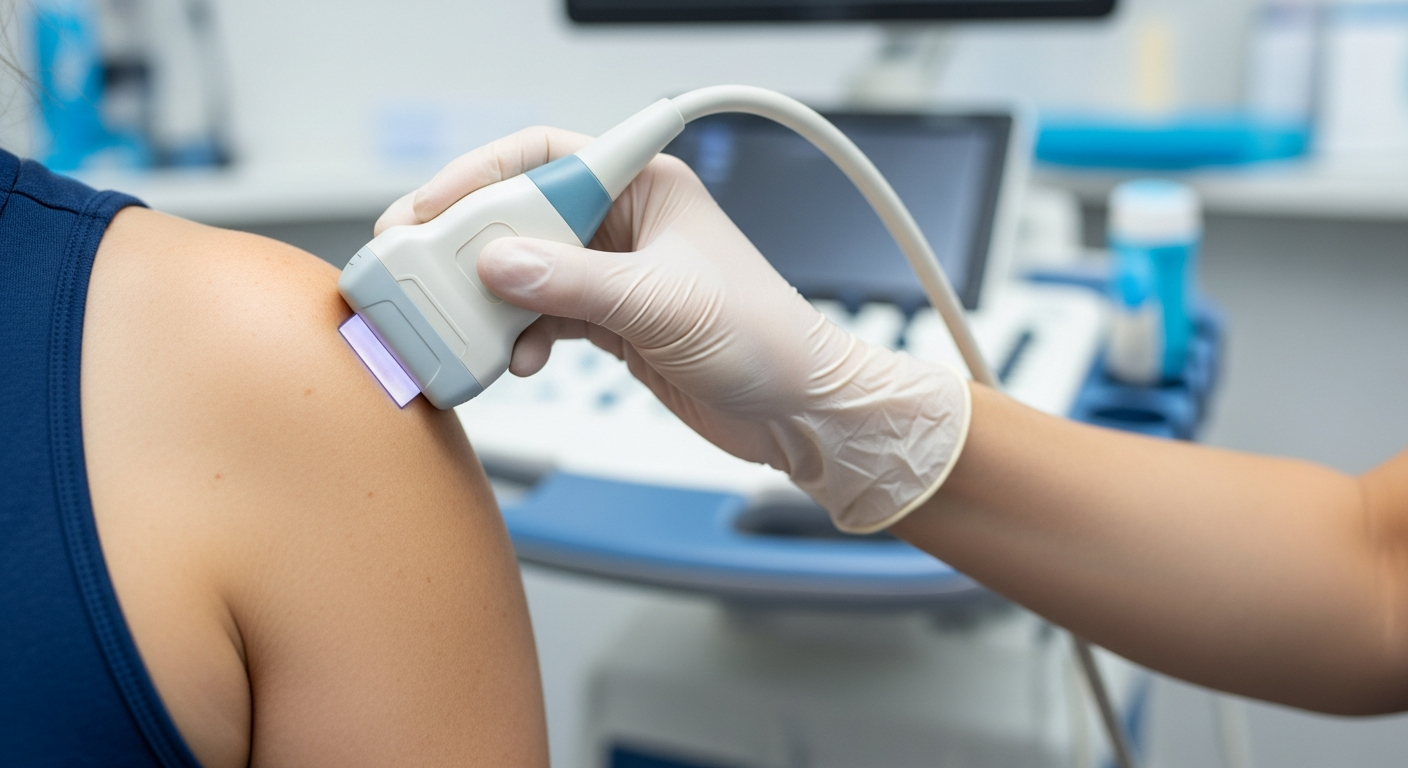
Musculoskeletal ultrasound uses high-resolution sound waves to examine muscles, tendons, ligaments, bursae and soft tissue lumps. There is no radiation and no injection, and the examination happens in real time — structures can be watched moving and loaded, which is what separates it from a still image.
This page is for the areas that do not have a page of their own. A torn calf, a pulled hamstring, forearm pain from gripping, a lump in the thigh, a groin strain that has not settled — all are accessible to ultrasound and all are scanned here.
If your problem is a named joint, the dedicated page will serve you better: shoulder, knee, hip, elbow, wrist, hand, ankle and foot.
Why might I need an MSK scan?
Soft tissue injuries follow a pattern: something is loaded beyond what it was ready for, and the tissue changes. Muscle tears and tendon problems both do this, but they behave differently and recover on different timelines — which is why naming the structure matters more than naming the pain.
A scan turns “my calf went” into a graded muscle tear at a specific site with a measurement beside it. That is what allows a physiotherapist to give you a realistic return-to-sport timeline rather than a guess.
- A calf or hamstring that went suddenly during sport
- A muscle injury you want graded before returning to training
- Forearm or shin pain that has built with load
- A soft tissue lump anywhere you want identified
- Swelling after an injury that has not settled
- Pain in an area without its own dedicated scan page
- Muscles — tears graded, with the site and extent measured
- Tendons anywhere accessible, at rest and under load
- Ligaments and their integrity after a sprain
- Bursae and fluid collections
- Soft tissue lumps — cyst, lipoma, ganglion or solid
- Haematomas, measured and followed where needed
- The other side for comparison where it helps
Inability to bear weight after an injury, a visibly deformed limb, sudden severe calf pain with swelling and warmth, or an area that becomes hot and red with fever needs urgent assessment rather than a booked scan — A&E or NHS 111. Sudden calf swelling in particular can indicate a blood clot, which is assessed through the NHS same-day pathway.
Is this scan suitable for me?
A msk ultrasound is a good fit if any of these sound like you:
- ✓Your injury does not match any of our named joint pages
- ✓You want a muscle tear graded before returning to sport
- ✓A lump needs identifying rather than watching
- ✓Swelling after an injury has not settled as expected
- ✓Load-related pain has built over weeks in an unusual site
- ✓You want the least invasive assessment first
And when it is not the right booking
You suspect a fracture — bone needs an X-ray, and we do not offer X-ray.
The problem is inside a joint — menisci, cruciate ligaments, labrum and cartilage need MRI. We will tell you if that is what your story points at.
You have sudden calf swelling with warmth — that needs same-day assessment for a possible clot through NHS 111 or your GP, not a booked appointment.
If a msk ultrasound is not the right test for you, we will say so before you book — not after.
What happens on the day
- 1
Tell us the area when you bookBecause this scan covers anywhere accessible, knowing the region in advance lets us set up the right probe and allow the right time. 30 minutes, no referral.
- 2
Your history firstHow it happened, whether there was a distinct moment, what provokes it now, and what you have already tried.
- 3
Scanning at restWarm gel and a high-resolution transducer over the area, with the surrounding structures examined rather than just the sore spot.
- 4
Assessed under loadWhere movement is part of the problem, the structure is watched working — muscle contracting, tendon gliding, joint moving.
- 5
Comparison where it helpsThe other side is often scanned too, since normal appearances vary between people.
- 6
Findings explained on screenYou see what we see during the scan, with the written report usually with you within two hours.
Understanding soft tissue injury
Three tissue types, three different recoveries.
Muscle tears
Graded by how much of the muscle is disrupted and where the tear sits. Injuries at the muscle-tendon junction behave differently from those in the muscle belly, and the site influences how long return to sport takes.
Tendon problems
Usually degenerative rather than inflamed. The tissue thickens and disorganises under load, and it responds to progressive loading rather than rest — which is why the label matters.
Lumps and collections
Most soft tissue lumps are benign — lipomas, cysts, ganglions. Ultrasound identifies which, measures it, and flags the small number whose appearance warrants a specialist opinion.
What your report might say
A finding is not automatically your diagnosis. Degenerative change in tendons is common in people with no symptoms at all. What makes a finding relevant is whether it sits where you hurt and fits your story — which is why the report is written to be read alongside an examination.
Any soft tissue area, assessed properly
A 30-minute appointment covering the region that actually hurts, explained on screen as we scan, with your written report usually within two hours.
How we scan soft tissue injuries
Scanned by the person reporting it
The sonographer who scans you writes your report. Nothing goes to a remote reader.
Not restricted to named joints
If the area is accessible to ultrasound, we scan it — calf, hamstring, groin, forearm, shin, anywhere soft tissue.
Graded, not just described
Muscle tears are graded and measured, because that is what a return-to-sport timeline is built on.
Honest routing
If your problem needs X-ray or MRI, the report says so and names the test rather than leaving it vague.
MSK ultrasound — your questions answered
What areas does this scan cover?
Can you grade a muscle tear?
When is the best time to scan a muscle injury?
Can ultrasound identify a lump?
Will it show a stress fracture?
Do I need a GP referral?
How long does the appointment take?
Can you scan more than one area?
Will you inject or treat the injury?
When will I get my report?
Other MSK scans we offer
Further reading: understanding your MSK report and persistent shoulder pain.
Where can you get a msk ultrasound in London?
Our clinic is at 5a Lucerne Mews, Kensington, London W8 4ED — a quiet mews three minutes on foot from Notting Hill Gate, serving Kensington, Notting Hill, Holland Park, Bayswater and central London.
Short-notice appointments are often available, including for people facing a long wait elsewhere. Call 0203 051 6506 for today’s availability.
Getting here
By tube: Notting Hill Gate — three minutes’ walk.
By bus: Routes along Notting Hill Gate and Kensington Church Street stop nearby.
By car: On-street parking nearby — full options in directions & parking.
When it does not fit a standard page
Any accessible soft tissue area assessed at rest and under load in a 30-minute appointment — explained on screen as we scan, with your report usually within two hours.
Kensington, London W8 4ED
3 mins from Notting Hill Gate
Written and clinically reviewed by the HCPC-registered sonographers who perform this scan at IUS London — a CQC-registered diagnostic ultrasound clinic (Provider ID 1-2775844974). Your own findings are explained to you at the scan and set out in your report.
Author: Yianni Kiromitis, Senior Sonographer, HCPC RA38415 — over 20 years’ experience in NHS and private ultrasound · Reviewed 10 August 2026