
Abdomen & Pelvis Ultrasound in London
For the bloating, discomfort or pain that refuses to declare which system it belongs to — the abdominal organs and the pelvic organs examined in one sitting, one report, one clear picture.
- Liver, gallbladder, pancreas, spleen, kidneys, uterus and both ovaries
- One appointment instead of two — and one integrated report
- Female chaperone present; every step explained before it happens
- Findings explained at the scan; written report usually within two hours
- No GP referral required — self-refer today
CQC-registered clinic · Provider ID 1-2775844974 · HCPC-registered sonographers
What is a combined abdomen and pelvis ultrasound?
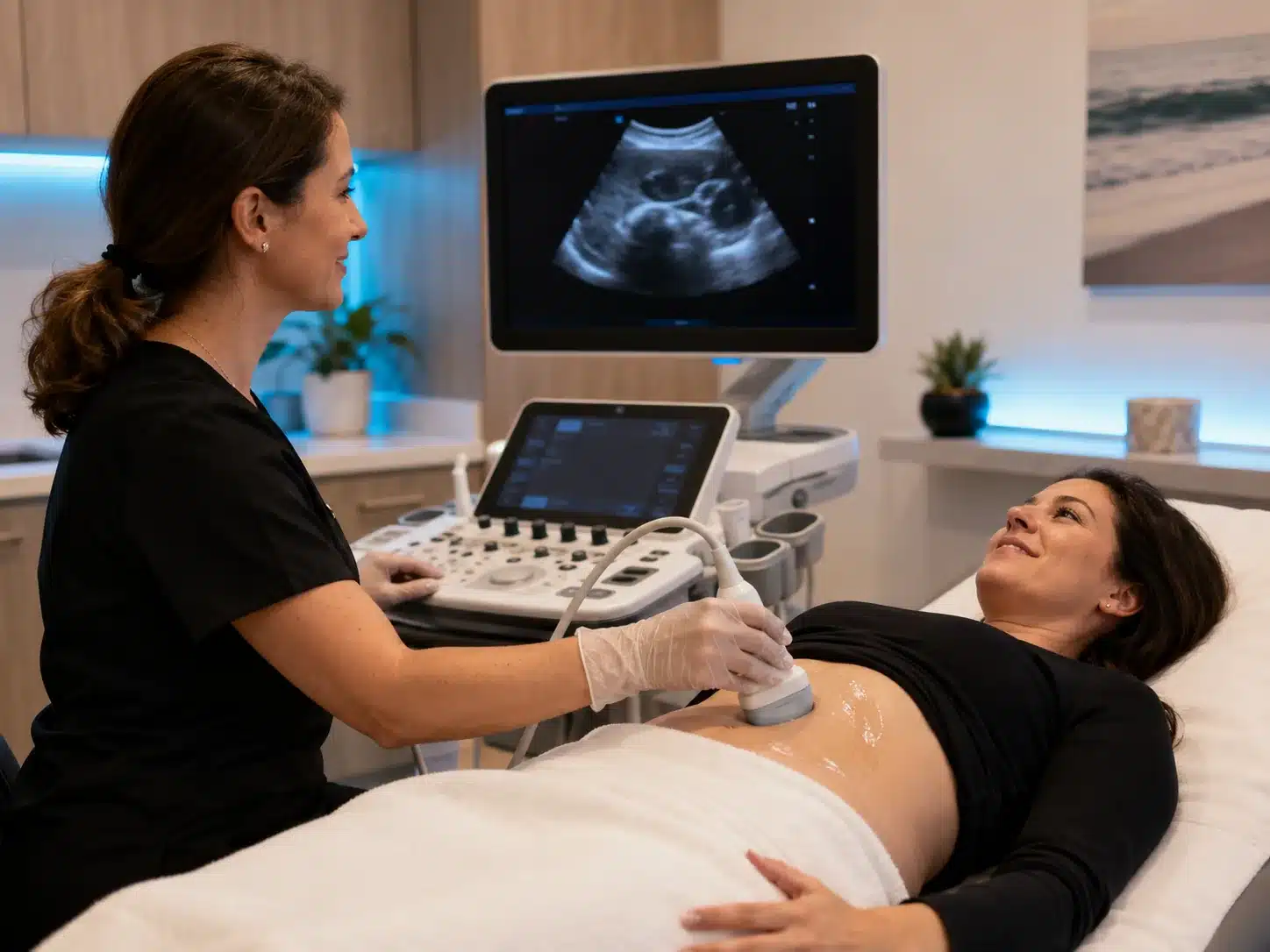
It is two complete examinations performed in a single 30-minute appointment. The upper abdomen is assessed first — liver, gallbladder, pancreas, spleen and both kidneys — and then the pelvis: the uterus, its lining, any fibroids, and both ovaries. One sonographer, one sitting, one report that reads the two territories together rather than in isolation. No needles, no radiation, and nothing to recover from afterwards.
Why might I need the abdomen and pelvis examined together?
Because symptoms do not read anatomy textbooks. Persistent bloating, lower abdominal discomfort, a feeling of fullness or pressure, pain that wanders between the upper and lower abdomen — any of these could originate from the ovaries and uterus, or just as plausibly from the gallbladder, liver or kidneys.
This examination is booked almost exclusively by the bloating-that-will-not-localise patient. From our side of the probe, evaluating both systems in one sitting is invaluable, because female pelvic and abdominal pathologies frequently overlap or mimic one another. And it prevents the immense frustration of a clear pelvic scan ending with “you now need to book an abdominal scan”: you leave with the full clinical picture, not half of one.
Sudden severe abdominal or pelvic pain, pain with fever and vomiting, fainting, or heavy unexpected bleeding are same-day emergencies for A&E or NHS 111, not scan bookings. Persistent bloating with appetite loss or unexplained weight loss should also see your GP promptly, alongside any scan.
- Liver, incl. fatty change
- Gallbladder and stones
- Pancreas
- Spleen
- Both kidneys
- Uterus size and shape
- Endometrial lining
- Fibroids and polyps
- Both ovaries
- Free fluid
Is this scan suitable for me?
The combined examination is the right booking if any of these sound like you:
- ✓Bloating or fullness that has persisted for weeks and will not localise
- ✓Pain that wanders between the upper and lower abdomen
- ✓You have been offered a pelvic scan but suspect the cause may be higher up
- ✓You want both territories cleared in one visit rather than two appointments
And when it is not the right booking
A clearly localised symptom — if the pain is squarely pelvic or squarely gallbladder, the single targeted scan is cheaper and just as good. Call and we will say which.
Bowel-pattern symptoms alone — gas blocks the ultrasound view, so bowel-related bloating largely evades this test. We will tell you that before you book, not after.
If a single targeted scan would answer your question, we will say so — before you book, not after.
How do I prepare, and what happens on the day?
Preparation matters doubly here, because the abdominal rules and the pelvic rules both apply — our preparation guide walks through them.
- 1
Fast for four hoursSips of water are fine. Fasting empties the gallbladder’s neighbours of gas, which is what makes stones visible.
- 2
Arrive with a comfortably full bladderThe full bladder lifts the bowel out of the way and gives the clearest window onto the uterus and ovaries.
- 3
Upper abdomen firstLiver, gallbladder, pancreas, spleen and kidneys, assessed systematically and narrated as we go.
- 4
Then the pelvisTransabdominally, and where it adds diagnostic value and you consent, transvaginally — a female chaperone present, the approach always your choice.
Why one sitting beats two appointments
Female abdominal and pelvic pathologies overlap and mimic one another constantly. Reading them together is a diagnostic advantage, not just a convenience.
Overlapping symptoms
An ovarian cyst, a gallbladder full of stones and an early fatty liver can all present as the same vague upper-and-lower discomfort. Only examining both territories separates them.
One report, one reader
The same sonographer sees both systems in the same half hour, so the findings are weighed against each other rather than arriving in two letters weeks apart.
The honest limit
Ultrasound reads solid organs superbly and bowel poorly — gas blocks the view. If the picture points at the bowel, the report says so and names the right next test.
Understanding your results and next steps
Findings are explained during the scan, and the written report follows usually within two hours — structured for your GP to act on, per our follow-up standard.
Booked separately, this would be
A pelvic ultrasound at £159 and an abdominal ultrasound at £159 — two appointments, two preparations, two reports arriving at different times.
The combined examination is £239: one visit, one preparation, one integrated report that reads both systems together.
You also avoid the outcome nobody wants — a normal pelvic scan that ends with being told to book another scan.
Bloating that will not localise deserves both systems looked at — short-notice appointments often available.
Why women choose IUS London for this
Two examinations, one unhurried half hour, and nothing left half-answered.
The full picture, first time
Both territories assessed in one sitting, so you never leave with half an answer and an instruction to book again.
Narrated as we scan
The screen is turned towards you and each organ explained as it is assessed — no silent examination in a darkened room.
You stay in control
The transvaginal approach is offered where it adds value, never assumed. Female chaperone present, every step explained first.
GP-ready in about two hours
One integrated report carrying both systems, written to be acted on rather than filed.
Why do patients choose IUS London?
Rated 4.9 across 476 Google reviews:
“Yianni was very helpful, knowledgeable and put me very much at ease. I will be going back and very much recommend.”
— Google review
“The staff were professional and made me feel comfortable. Highly recommend it!”
— Google review
“Amazing service. If you are looking for a clinic … this is the place to go.”
— Google review
The combined scan — your questions answered
How much does the abdomen and pelvis scan cost?
Is the transvaginal part compulsory?
Can this scan find the cause of my bloating?
What if something is found in only one system?
How should I prepare?
Do I need a referral?
Other women’s health scans we offer
Pelvic Ultrasound — £159
Heavy or painful periods, pelvic pain, fibroids and cysts — the uterus and ovaries assessed properly.
View service →
Endometrial Thickness — £159
Post-menopausal bleeding or HRT monitoring — the lining measured against the thresholds that matter.
View service →
Well-Woman Scan — £399
Abdomen, pelvis, urinary tract, aorta and thyroid, with a written report usually within two hours.
View service →
Further reading: pelvic pain — when to scan · symptoms of ovarian cysts · uterine fibroids
Where can you get an abdomen and pelvis ultrasound in London?
At IUS London — our CQC-registered clinic in Kensington, three minutes on foot from Notting Hill Gate station (Central, Circle and District lines).
5a Lucerne Mews, Kensington, London W8 4ED
30-minute appointments — short notice welcome
0203 051 6506 · Directions & parking
Getting here is the easy part
By tube: Notting Hill Gate — three minutes on foot.
By bus: Routes along Notting Hill Gate and Kensington Church Street stop nearby.
By car: On-street parking nearby — full options in directions & parking.
Both systems, one appointment
Because symptoms do not respect anatomical boundaries. Self-refer today — no GP letter required.
Kensington, London W8 4ED
3 mins from Notting Hill Gate
Written and clinically reviewed by the HCPC-registered sonographers who perform this scan at IUS London — a CQC-registered diagnostic ultrasound clinic (Provider ID 1-2775844974). Your own findings are explained to you at the scan and set out in your report.
Author: Yianni Kiromitis, Senior Sonographer, HCPC RA38415
Medically reviewed: 26 July 2026