Spotting and Bleeding in Pregnancy — Causes and When to Scan
Light bleeding in early pregnancy is common and often harmless — but it always deserves checking. The causes, what the colour and amount do and don’t tell you, and what happens next.
Bleeding in early pregnancy affects a substantial minority of pregnancies — commonly cited as somewhere around one in four — and the NHS position is worth stating plainly: it is relatively common, it does not always mean something is wrong, and it should always be checked. Many pregnancies that bleed in the first trimester continue entirely normally. Bleeding can also be the first sign of miscarriage or of an ectopic pregnancy, and no one can tell which from the bleeding alone — which is why assessment matters rather than waiting to see.
Heavy bleeding (soaking through a pad), severe or one-sided tummy pain, pain at the tip of your shoulder, or feeling faint, dizzy or collapsing. These can indicate an ectopic pregnancy or significant bleeding. For any bleeding that is not severe, still contact your GP, midwife, NHS 111 or an Early Pregnancy Assessment Unit the same day — many EPAUs accept self-referral.
Spotting or bleeding — what is the difference?
Spotting is light enough that you notice a few drops on underwear or when wiping — it would not fill a panty liner. Bleeding is heavier, enough that you need a liner or pad. The distinction is worth knowing because it is the first thing a clinician will ask, alongside colour and how long it has lasted.
On colour: brown blood is older blood that has taken time to leave the body, and often indicates bleeding that has already stopped. Bright red usually means active bleeding. Neither colour is a verdict — brown spotting can accompany a problem and bright red can accompany a pregnancy that continues perfectly well — but both are useful information to report.
What to do practically: use a pad rather than a tampon so you can see how much there is, avoid putting anything into the vagina and avoid sex until you have been assessed, and note when it started, the colour and whether there is pain. Then contact your GP, midwife or an EPAU — the same day for anything more than the very lightest spotting.
What causes bleeding in early pregnancy
Implantation bleeding. Light spotting roughly six to twelve days after conception, as the embryo embeds into the womb lining. It is usually brief — hours to a couple of days — and lighter than a period. Because the timing coincides with an expected period, it is frequently mistaken for one.
Breakthrough bleeding. Some women experience light bleeding around the times their period would have been due in the early weeks, as hormone levels settle. It typically settles as pregnancy progresses.
A sensitive cervix. Pregnancy increases the blood supply to the cervix, making it more delicate. Bleeding after sex, after an internal examination or after a smear test is common for this reason and is not usually a sign of a problem — though it should still be mentioned rather than assumed.
Infection. Vaginal or cervical infections can cause spotting and are treatable, which is a good reason to have bleeding assessed rather than waited out.
Miscarriage. Bleeding, often with cramping period-like pain, can indicate a pregnancy that is ending. Where a scan still shows a heartbeat this is described as a threatened miscarriage — a description of symptoms, not an outcome, and many such pregnancies continue. Our guide to miscarriage and ultrasound covers how this is assessed.
Ectopic pregnancy. Bleeding with one-sided pain, particularly with shoulder-tip pain or faintness, needs emergency assessment. This is the possibility that makes waiting unwise, even though it is far from the commonest cause.
Molar pregnancy. A rare condition in which abnormal tissue develops instead of a normal pregnancy, sometimes causing bleeding and unusually high pregnancy hormone levels. It is treatable, and identified on ultrasound.
Later in pregnancy the causes differ — including problems with the position of the placenta — and bleeding at any stage after the first trimester should always be reported to your maternity team promptly.
What a scan can tell you — and when
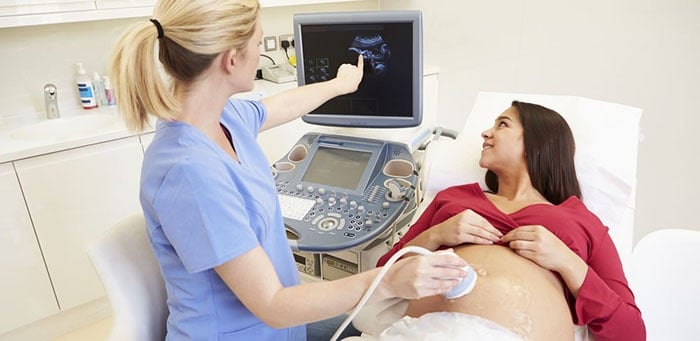
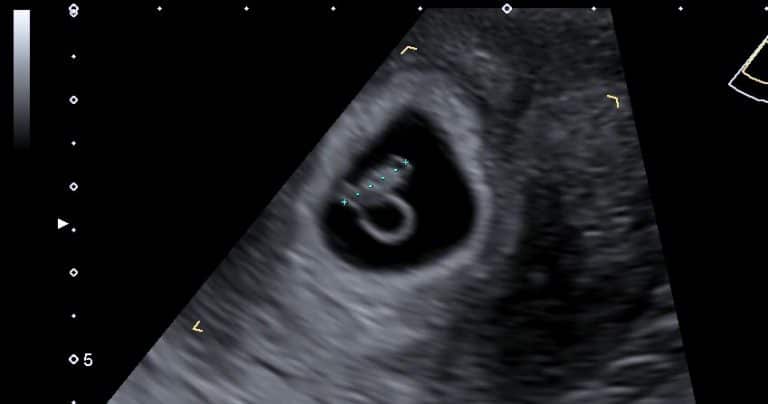
An ultrasound in this situation is answering three questions: is the pregnancy inside the uterus, is it developing, and is there a visible cause for the bleeding. What it can establish depends heavily on how far along you are. Before about five weeks there may be nothing visible even in a completely healthy pregnancy, so a scan often cannot conclude anything and blood tests do more of the work. From six to seven weeks onwards a scan becomes considerably more informative — our 6 week and 7 week guides set out what is visible when.
Where bleeding is the reason for the scan, the NHS Early Pregnancy Assessment Unit is the right route: they scan, take hCG blood tests where needed, and provide continuity through whatever the answer turns out to be. Many accept self-referral without a GP appointment. A private scan can be useful alongside that — for instance if the NHS appointment is further away than you can bear — but for bleeding with pain, it should not be the first port of call.
And to answer the question people worry about: having a scan does not cause bleeding or miscarriage, including an internal scan. Light spotting occasionally follows a transvaginal scan because the cervix is delicate in pregnancy; it is not a sign of harm. Our guide to ultrasound safety covers this fully.
Your questions answered
Is spotting in early pregnancy normal?
Does bleeding mean I am having a miscarriage?
What does brown spotting mean in pregnancy?
How much bleeding is too much?
Can sex cause bleeding in pregnancy?
Can an internal scan cause bleeding or miscarriage?
Should I go to the NHS or book privately?
Where to go from here
What a scan can and cannot detect, and how early loss is confirmed.
Read the guide →
UrgentEctopic PregnancyThe symptoms that need emergency care, and how it is diagnosed.
Read the guide →
6 Weeks6 Week Pregnancy ScanWhat is visible this early, with real scan images.
Read the guide →
If a scan would help alongside NHS care
Early pregnancy scanning by HCPC-registered sonographers, findings explained on screen, and a written report usually within two hours — written so your GP, midwife or EPAU can act on it. For bleeding with pain, please contact NHS services first.
Kensington, London W8 4ED
3 mins from Notting Hill Gate
Guidance on bleeding in pregnancy follows NHS guidance on vaginal bleeding in pregnancy and NHS guidance on miscarriage. This article is general information, not individual medical advice — any bleeding in pregnancy should be reported to your GP, midwife or an Early Pregnancy Assessment Unit, and urgent symptoms need urgent assessment.
Written and clinically reviewed by the HCPC-registered sonographers who perform this scan at IUS London — a CQC-registered diagnostic ultrasound clinic (Provider ID 1-2775844974). Your own findings are explained to you at the scan and set out in your report.
Author: Yianni Kiromitis, Senior Sonographer, HCPC RA38415
Medically reviewed: 1 August 2026