Is Ultrasound Safe?
Yes — and the honest version of that answer is worth two more minutes of your time, because the real risks of scanning have nothing to do with sound waves.

Diagnostic ultrasound has been used in medicine for over six decades, and its safety record across that time is exceptional: used within clinical guidelines, it has no confirmed harmful effects. Unlike X-rays and CT scans, ultrasound uses no ionising radiation — it creates images from high-frequency sound waves, which is why it is the default imaging for pregnancy, safe to repeat as often as clinically needed, and suitable for children. That is the short answer. The longer answer covers what the machine actually monitors, what pregnancy scanning guidance says, and where the genuine risks of private scanning sit — because they are human, not physical.
Why sound waves are not radiation
An ultrasound transducer sends pulses of sound at frequencies far above hearing — roughly 2 to 15 megahertz — into the body and listens for the echoes. Different tissues reflect sound differently, and the machine assembles those echoes into a live image. Nothing ionising is involved: sound at these intensities does not break chemical bonds or damage DNA, which is the mechanism by which X-ray and CT carry their (small, managed) radiation dose.
Two physical effects do exist, and modern machines measure both continuously. Sound passing through tissue can deposit a small amount of heat (tracked as the thermal index, TI) and can interact with microscopic gas bubbles (tracked as the mechanical index, MI). Diagnostic scanning keeps both comfortably within limits set by international safety bodies, the indices are displayed on screen throughout, and sonographers are trained to the ALARA principle — as low as reasonably achievable: the minimum acoustic output and scanning time that answers the clinical question. That principle, not any documented harm, is why professional guidance says every scan should have a purpose.
Is ultrasound safe in pregnancy?
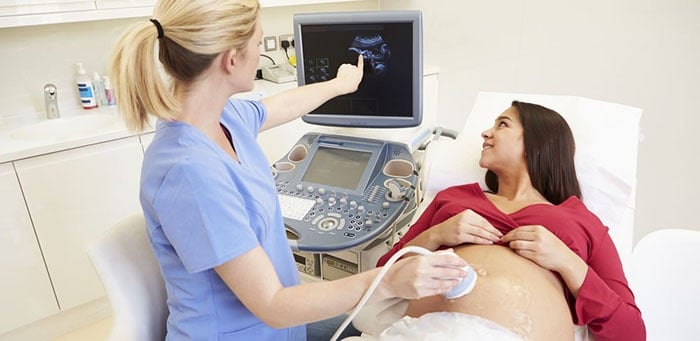
Pregnancy scanning is the most studied use of ultrasound, and NHS guidance is clear: routine scans, performed when indicated, have no known risks to mother or baby. It is precisely because ultrasound is radiation-free that it is the standard way of monitoring pregnancy from the earliest weeks — and why we scan throughout pregnancy without hesitation when there is a question to answer.
The same prudent-use principle applies here with extra weight: a scan should be performed by a qualified professional, for a clinical or well-defined purpose, at diagnostic settings. It is why we take a position against souvenir-style “bonding” scanning and against casual at-home scanning — not because the sound waves are dangerous, but because scanning without a diagnostic question, by people without diagnostic training, offers risk-shaped downsides (missed findings, false reassurance) with no clinical upside.
The real risks are human, not physical
When people ask “is a private ultrasound safe?”, the physics is the easy half. The risks that actually materialise in the private scanning market are these:
- 1
Operator dependenceUltrasound is only as good as the person holding the probe and writing the report. An unqualified or inexperienced operator can miss findings or mischaracterise them — our guide to preventing ultrasound misdiagnosis explains how to protect yourself, starting with checking HCPC registration.
- 2
False reassuranceA limited “reassurance scan” that wasn’t designed to answer your actual question can send you away comforted and undiagnosed. A safe scan is a targeted scan with a written, actionable report.
- 3
Incidental findings and anxietyScanning finds things — most of them harmless. Without honest, proportionate explanation at the appointment, a benign cyst can cost you weeks of worry. Findings deserve context, urgency labels, and a clear next step, in the room and in the report.
- 4
Broken continuity of careA scan that never reaches your GP is a dead end. Reports should be written so your NHS care can act on them — private imaging should connect into your healthcare, not sit apart from it. That standard is what our follow-up care page documents.
Every one of these risks is avoidable with the checks in our guide to choosing a private ultrasound clinic: CQC registration, verifiable HCPC sonographers, transparent pricing, and a proper report standard.
Ultrasound safety — your questions answered
Is ultrasound safe during pregnancy?
How often can I safely have an ultrasound scan?
Does an ultrasound scan hurt?
Is ultrasound safe for children?
What are the thermal and mechanical indices on the screen?
Keep reading
How the technology works, what a scan involves, and what the images actually show.
Read the guide →
Choosing WellHow to Choose a ClinicThe five checks that separate clinics you can verify from clinics you take on trust.
Read the checklist →
The Real RiskPreventing MisdiagnosisWhy operator skill is the safety variable that matters — and how to check it.
Read the guide →
Scanned safely, explained honestly
HCPC-registered sonographers, a clinical question behind every scan, and a written report your GP can act on — usually within two hours.
Kensington, London W8 4ED
3 mins from Notting Hill Gate
Safety positions on this page reflect published guidance from the NHS (Ultrasound scan) and the safety framework of the British Medical Ultrasound Society (BMUS), including the ALARA prudent-use principle. This article is general information, not individual medical advice — if in doubt about a symptom, speak to your GP or call NHS 111.
Written and clinically reviewed by the HCPC-registered sonographers who perform this scan at IUS London — a CQC-registered diagnostic ultrasound clinic (Provider ID 1-2775844974). Your own findings are explained to you at the scan and set out in your report.
Author: Yianni Kiromitis, Senior Sonographer, HCPC RA38415
Medically reviewed: 31 July 2026