Understanding the NIPT Test
How non-invasive prenatal testing works, what its accuracy figures actually mean, when the NHS offers it — and why “99% accurate” is the most misunderstood number in prenatal screening.
Non-invasive prenatal testing (NIPT) is a maternal blood test that analyses fragments of placental DNA circulating in your bloodstream to estimate the chance that your baby has Down’s syndrome (trisomy 21), Edwards’ syndrome (trisomy 18) or Patau’s syndrome (trisomy 13). It can be done from around 10 weeks, it carries no risk to the pregnancy, and it is considerably more accurate than the combined screening test. It is also, importantly, still a screening test — and understanding what that means is the difference between reading your result correctly and misreading it badly.
NIPT is a laboratory blood test, not an ultrasound examination, and we are a diagnostic imaging clinic — we do not provide it or take samples for it. On the NHS it is offered to those whose combined screening returns a higher-chance result; privately it is available through providers who arrange the blood draw and laboratory analysis. This guide exists so you can understand the test wherever you have it.
What the test actually measures
During pregnancy, small fragments of DNA from the placenta cross into your bloodstream — known as cell-free DNA. From about 10 weeks there is usually enough of it to analyse. A laboratory counts the DNA fragments belonging to each chromosome and looks for an excess: an extra copy of chromosome 21 produces slightly more chromosome-21 fragments than expected, and the same principle applies to chromosomes 18 and 13.
Two details matter and are often skipped. First, the DNA analysed comes from the placenta, not directly from the baby — usually identical, but occasionally the placenta carries a chromosomal pattern the baby does not, which is one reason a positive result must be confirmed. Second, the test depends on there being enough placental DNA in the sample — the fetal fraction. If it is too low, the laboratory cannot give a result and you are asked for a repeat sample. This happens more often when testing very early or at higher body weight, and a “no result” is a technical outcome, not a finding about your baby.
Timing matters for exactly this reason. Our NIPT eligibility and timing calculator works out when you would be eligible based on your dates.
What “99% accurate” really means
NIPT is frequently advertised as over 99% accurate for Down’s syndrome, and that figure is broadly right — but it describes sensitivity: of pregnancies that do have the condition, the test correctly identifies more than 99 in 100. That is not the same as the question you actually care about, which is: given that my result came back positive, what is the chance my baby actually has the condition?
That second figure is the positive predictive value, and it depends heavily on how common the condition is in someone with your background chance. Because these conditions are uncommon, a very accurate test applied to a large population still produces a meaningful number of false positives. In practice this means positive predictive value is high when NIPT follows a higher-chance combined screening result, and considerably lower when NIPT is used as a first-line test in someone at low background risk — and lower again for the rarer conditions such as trisomy 13 and the sex-chromosome conditions, where a positive result is wrong more often than people expect.
None of this makes NIPT a poor test — it is far better than what preceded it. It means a positive NIPT result is a strong reason to have a diagnostic test, not a diagnosis in itself. Your result letter or clinician should give you a personalised chance rather than a generic accuracy percentage; if it does not, that is a fair thing to ask for.
When NIPT is offered, and what comes next
In England, NIPT is offered on the NHS as an additional test to those whose combined screening returns a higher-chance result — the threshold being 1 in 150 or greater. It is offered as an alternative to going straight to a diagnostic test, and many people choose it precisely because it avoids the small miscarriage risk that CVS and amniocentesis carry. Outside that pathway, NIPT is available privately.
If NIPT returns a higher-chance result, the next step is a diagnostic test — chorionic villus sampling (from about 11 to 14 weeks) or amniocentesis (from about 15 weeks) — which examines the baby’s own cells and gives a definitive answer. Declining further testing is also a legitimate choice, and one some people make knowing the result would not change what they do next.
Whichever way your results go, the NHS screening pathway includes access to a screening midwife or specialist to talk it through. That conversation is part of the programme, not an imposition on it, and it is worth using.
NIPT and scanning answer different questions
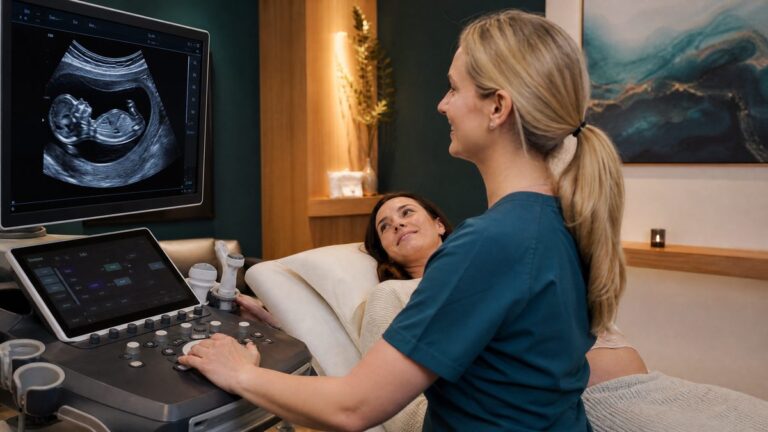
NIPT assesses chromosomes. Ultrasound assesses structure. They are complementary rather than competing, and neither substitutes for the other: NIPT cannot see a heart defect or a spinal difference, and no scan can count chromosomes. This is why the NHS pathway includes both a nuchal translucency measurement in the first trimester and an anomaly scan at around 18 to 21 weeks, whatever your NIPT result showed.
A normal NIPT result is genuinely reassuring about the specific chromosomal conditions it tests for — and it says nothing at all about the many other things a pregnancy scan looks at. Both parts of the pathway are worth attending.
Your questions answered
How accurate is NIPT really?
Is NIPT a diagnostic test?
From what week can I have NIPT?
What does a “no result” or failed NIPT mean?
Does NIPT replace the 12-week scan?
Can NIPT tell me the baby’s sex?
Do you offer NIPT at IUS London?
Understanding your screening
The measurement, the 1 in 150 threshold, and why screening is not diagnosis.
Read the guide →
ToolNIPT Timing CalculatorWork out when you would be eligible, based on your dates.
Open the calculator →
18–21 WeeksThe Anomaly ScanWhat the mid-pregnancy scan checks that no blood test can.
Read the guide →
The scanning side of your pregnancy
We do not provide NIPT, but dating, viability and growth scanning we do — explained on screen as it happens, with a written report usually within two hours for your GP or midwife.
Kensington, London W8 4ED
3 mins from Notting Hill Gate
NHS eligibility, thresholds and terminology follow NHS guidance on screening for Down’s, Edwards’ and Patau’s syndromes. Accuracy figures describe detection rates; positive predictive value varies with background chance and should be interpreted with your screening team. This article is general information, not individual medical advice.
Written and clinically reviewed by the HCPC-registered sonographers who perform this scan at IUS London — a CQC-registered diagnostic ultrasound clinic (Provider ID 1-2775844974). Your own findings are explained to you at the scan and set out in your report.
Author: Yianni Kiromitis, Senior Sonographer, HCPC RA38415
Medically reviewed: 1 August 2026