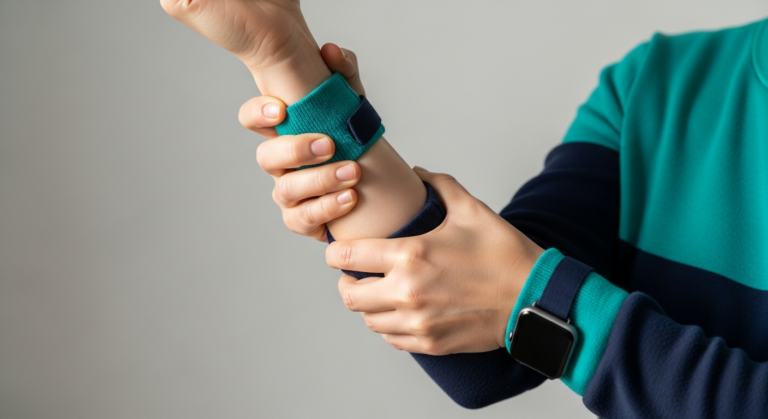
Wrist Pain or Hand Numbness — Carpal Tunnel and Beyond
Which fingers go numb tells you a great deal. Here is how to read the pattern, and what ultrasound adds to the diagnosis.

Numbness in the hand is not all one condition. The median nerve, the ulnar nerve and the nerve roots in the neck each supply a different territory, and which fingers are affected usually points straight at the culprit. Getting that right matters, because a wrist splint does nothing for a problem coming from the neck.
Which fingers, and what it means
| What you notice | Commonly |
|---|---|
| Thumb, index, middle and half the ring finger — worse at night, shaking the hand helps | Carpal tunnel syndrome (median nerve at the wrist) |
| Little finger and half the ring finger, worse with the elbow bent | Ulnar nerve at the elbow |
| Numbness with neck pain, in a stripe down the arm | Coming from the neck |
| Pain at the thumb side of the wrist, worse gripping or lifting a baby | De Quervain’s tenosynovitis |
| A firm painless lump on the back of the wrist | Ganglion cyst |
| Whole hand numb, both hands, no clear pattern | Needs GP assessment — several causes, some general |
Do not wait on constant numbness or weakness
Numbness that has become constant rather than intermittent, visible wasting of the muscle at the base of the thumb, or weakness dropping things should go to your GP promptly — nerve compression left long enough can leave lasting changes. Sudden numbness with weakness on one side of the body, or with face or speech changes, is a 999 call.
What ultrasound adds — and what it is not
Ultrasound can see the median nerve directly. In carpal tunnel syndrome the nerve typically swells just before it enters the tunnel, and measuring its cross-sectional area supports the diagnosis. The scan also finds the less common causes — a ganglion, thickened tendon sheaths, or an unusual anatomy crowding the tunnel — which changes what treatment makes sense.
What it is not is a nerve conduction study. Those tests measure how well the nerve is working and grade severity; ultrasound shows what the nerve looks like. Surgeons often want the conduction study before operating, and it is arranged through your GP. The two are complementary, and we offer only one of them.
How the appointment runs
- 1
Tell us the patternWhich fingers, when it is worst, and whether anything relieves it. That shapes what we examine. 30 minutes, no referral, no preparation.
- 2
The scanThe median nerve measured at the wrist, the tendon sheaths assessed, and the ulnar nerve at the elbow checked if your pattern suggests it.
- 3
ComparisonThe other hand is usually scanned too — a nerve measurement means more against your own other side.
- 4
ResultsExplained on screen as we scan, written report usually within two hours — and it says plainly if nerve conduction studies are the next step.
Your questions answered
Can ultrasound diagnose carpal tunnel syndrome?
Why is it worse at night?
What is the difference between this and a trapped nerve in the neck?
Can you see a ganglion cyst?
Do I need surgery?
Is de Quervain’s the same thing?
See the nerve, not just the symptom
Median nerve measured at the wrist, tendon sheaths and ulnar nerve assessed as your pattern requires — explained on screen as we scan, with the written report usually within two hours.
Kensington, London W8 4ED
3 mins from Notting Hill Gate
This article is general information about wrist pain and hand numbness, not individual medical advice. Constant numbness, muscle wasting or weakness needs prompt GP assessment — see NHS guidance on carpal tunnel syndrome. We provide diagnostic ultrasound only; we do not perform nerve conduction studies, X-ray, MRI or injections.
Written and clinically reviewed by the HCPC-registered sonographers who perform this scan at IUS London — a CQC-registered diagnostic ultrasound clinic (Provider ID 1-2775844974). Your own findings are explained to you at the scan and set out in your report.
Author: Yianni Kiromitis, Senior Sonographer, HCPC RA38415 — over 20 years’ experience in NHS and private ultrasound
Medically reviewed: 9 August 2026