The Annual Well Woman Ultrasound — Who Is It Actually For?
An honest look at what a whole-body women’s scan covers, what it cannot replace, and why “annual” is a marketing interval rather than a clinical one.

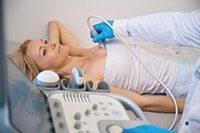
A well woman ultrasound examines the pelvic organs, the abdominal organs, the kidneys, the thyroid and the breasts in a single appointment. It takes about an hour, and it produces a thorough picture of your anatomy at that moment.
We offer it, so what follows should be read with that in mind. It is worth setting out plainly what this scan is good for and what it is not, because whole-body screening is an area where private clinics routinely overpromise.
What it covers — and what it cannot replace
| Included in the scan | Not covered — and not replaceable by ultrasound |
|---|---|
| Womb, lining and both ovaries | Cervical screening — a smear test, through the NHS |
| Liver, gallbladder, pancreas, spleen | Breast screening — mammography detects microcalcifications that ultrasound cannot see |
| Both kidneys and the bladder | Bowel cancer screening — the NHS home test kit |
| Thyroid and neck | Blood pressure, cholesterol, diabetes and thyroid function — blood tests and a GP check |
| Breasts and armpits | Bone density, and anything inside gas-filled bowel |
| Abdominal aorta | Cancers that ultrasound simply does not detect well |
The right-hand column matters more than the left. Attending your NHS cervical screening, breast screening and bowel screening invitations is worth more than any private scan, and those programmes exist because they have been shown to save lives at population level. A well woman scan sits alongside them, never in place of them.
The case for, and the case against
The honest case for. It finds things that are genuinely useful to know about — fibroids, ovarian cysts, gallstones, fatty liver, kidney stones, thyroid nodules, an aortic aneurysm. Several of those are silent until they are not, and knowing changes what you and your GP do next. If you have symptoms you have been ignoring, or a family history that makes you want a baseline, that is a reasonable use of it.
The honest case against. Scanning healthy people finds incidental things — small cysts, a benign nodule, a haemangioma in the liver — that would never have caused you any trouble. Each one then generates follow-up scans, sometimes referrals, and reliably generates worry. That is a real cost, not a hypothetical one, and it falls hardest on people who were perfectly well.
Which is why “annual” is not a clinical recommendation. No evidence establishes yearly whole-body ultrasound as beneficial for people without symptoms, and we will not pretend otherwise to sell a repeat booking. A baseline scan, or a scan prompted by a specific concern, is a defensible choice. A standing yearly appointment mostly is not.
How the appointment runs
- 1
PreparationDo not eat for four hours beforehand, and arrive with a comfortably full bladder. Water is fine and take your usual medicines.
- 2
The appointmentAbout an hour — longer than a single-region scan because of the ground it covers. A transvaginal scan gives the clearest pelvic view; transabdominal is available if you prefer.
- 3
Explained as we goEvery region talked through on screen as we scan, rather than saved up for a letter.
- 4
ResultsThe written report is usually with you within two hours — setting out findings by region, and stating plainly which need action, which need nothing, and which your GP should follow up.
Your questions answered
Should I have one every year?
Does it replace my smear test?
Does it replace breast screening?
Can it detect ovarian cancer early?
What if something incidental is found?
How long does it take?
Where to go from here
A thorough baseline, honestly reported
Pelvis, abdomen, kidneys, thyroid and breasts in one appointment of about an hour — explained on screen as we scan, with a written report usually within two hours that says which findings need action and which need none.
Kensington, London W8 4ED
3 mins from Notting Hill Gate
This article is general information about whole-body ultrasound, not individual medical advice. A private scan does not replace NHS cervical screening, breast screening or bowel screening — attend those when invited. Ultrasound does not assess bowel, bone density or blood chemistry; we do not offer mammography, biopsy or blood tests.
Written and clinically reviewed by the HCPC-registered sonographers who perform this scan at IUS London — a CQC-registered diagnostic ultrasound clinic (Provider ID 1-2775844974). Your own findings are explained to you at the scan and set out in your report.
Author: Yianni Kiromitis, Senior Sonographer, HCPC RA38415 — over 20 years’ experience in NHS and private ultrasound
Medically reviewed: 9 August 2026