Endometrial Thickness by Age and Life Stage
What a normal womb lining measures before and after the menopause and on HRT, the thresholds used in the UK, and what happens if yours is above them.
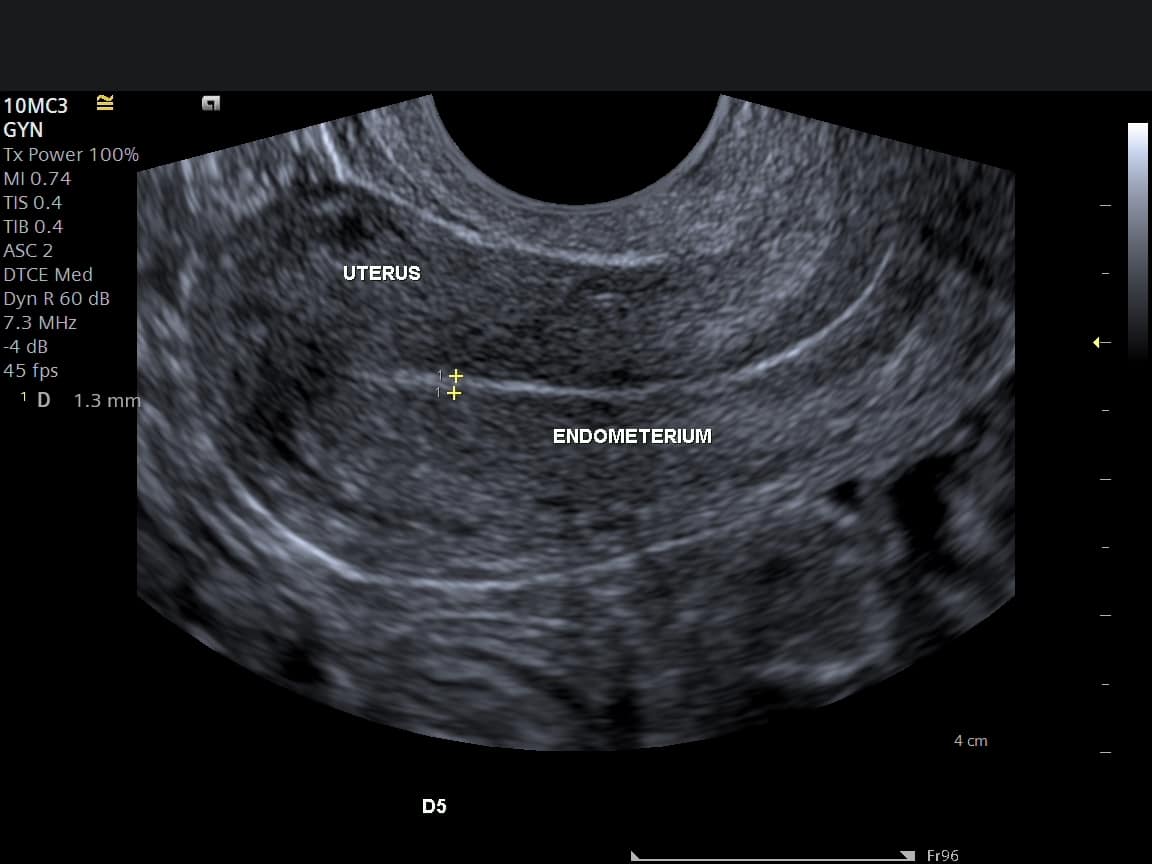
Endometrial thickness depends less on your age than on your life stage. Before the menopause the lining changes through each cycle, from 1 to 4 mm during a period to as much as 16 mm before the next. After the menopause it is thin, and 4 mm is the key UK threshold for women with bleeding. On HRT, the threshold depends on the type of HRT.
The endometrium is the lining of the womb. It is measured in millimetres, ideally on a transvaginal (internal) scan, across its thickest point in the long view of the womb. The number only means something alongside your life stage, any HRT you take, and whether you have had bleeding.
When we measure the lining of a woman on HRT, the report names the type of HRT and the action that goes with the number. Our endometrial thickness scan page explains the appointment itself.
Bleeding a year or more after your last period should be checked by your GP. NICE recommends an urgent suspected cancer referral for anyone aged 55 or over with bleeding after the menopause, and considering one for those under 55. Very heavy bleeding with dizziness or fainting is an emergency: call 999 or go to A&E.
What is a normal endometrial thickness at each life stage?
These are typical ranges. Women vary, so a measurement is always read with your history.
| Life stage | Typical thickness | What it means |
|---|---|---|
| During a period (days 1 to 4) | 1 to 4 mm | A thin, bright line: the lining has shed |
| Early cycle (about days 5 to 13) | 5 to 7 mm | The lining is rebuilding |
| Around ovulation | Up to about 11 mm | A layered, “triple line” look |
| Second half of the cycle (days 16 to 28) | 7 to 16 mm | At its thickest before a period |
| After the menopause, no HRT, with bleeding | 4 mm or less is reassuring | Over 4 mm needs further assessment |
| Sequential HRT, unscheduled bleeding | 7 mm or less is reassuring | Over 7 mm: urgent referral |
| Continuous combined HRT, unscheduled bleeding | 4 mm or less is reassuring | Over 4 mm: urgent referral |
Cycle ranges are typical values used in ultrasound practice. The 4 mm threshold after the menopause follows UK referral pathways; the thresholds on HRT are from the 2026 British Menopause Society guideline.
Why does the lining change before the menopause?
Through each cycle, oestrogen builds the lining up and, after ovulation, progesterone prepares it for a possible pregnancy. If no pregnancy follows, the lining sheds as a period and the cycle starts again. That is why a 12 mm lining can be entirely normal in the second half of a cycle and unusual a week after a period.
Because the range is so wide, a routine look at the lining is best done early in the cycle, around days 5 to 10, when it varies least. A scan for symptoms is timed around the symptoms instead.
What is normal after the menopause?
Without the monthly hormone cycle, the lining becomes thin. For women with bleeding after the menopause, a lining of 4 mm or less makes endometrial cancer unlikely, and UK pathways use 4 mm as the dividing line. Above 4 mm, the lining is assessed further, usually with a biopsy, a hysteroscopy (a camera into the womb), or both.
A thin lining is reassuring, not a guarantee. If bleeding continues, see your GP again. A thicker lining found by chance in a woman with no bleeding is handled differently, and your GP or gynaecologist will advise.
What thickness is normal on HRT?
It depends on the type of HRT. On sequential HRT you take a progestogen for part of each month and usually have a monthly bleed. On continuous combined HRT you take it every day and should not bleed once you are established on it.
Bleeding you would not expect on your HRT is called unscheduled bleeding. It is common in the first six months after starting or changing HRT; after that, it is usually investigated. When it is, the 2026 British Menopause Society guideline, written with the RCOG, the RCGP and other UK bodies, sets these thresholds:
- Sequential HRT: 7 mm or less is reassuring; over 7 mm means an urgent suspected cancer referral for assessment.
- Continuous combined HRT: 4 mm or less is reassuring; over 4 mm means an urgent suspected cancer referral.
If the whole lining cannot be seen clearly, the guideline advises urgent assessment within six weeks, even when the part that can be seen is within normal limits. Below the threshold, the usual next step is adjusting the HRT for up to six months, with further assessment if the bleeding becomes heavy or does not settle. If you have no bleeding and a thickened lining is found by chance, the guideline advises assessment at 10 mm or more.
How we report the lining on HRT
When a woman on HRT has her lining measured with us, the report follows the British Menopause Society pathway. On sequential HRT, over 7 mm: urgent referral on the two-week suspected cancer pathway is recommended, and we notify the referrer; 7 mm or under: optimise HRT as per the BMS pathway. On continuous combined HRT, over 4 mm: urgent two-week referral is recommended, and we notify the referrer; 4 mm or under: optimise HRT as per the BMS pathway. Where the clinical history we are given is incomplete, the report gives the measurement and asks the referrer to follow the BMS guideline for onward management.
That is why it helps to tell us which HRT you take, how long you have taken it and when the bleeding started. What your own measurement means is explained at the scan and set out in your report; the decision about referral rests with your GP or gynaecologist.
What happens if my lining is thicker than expected?
A thicker lining is a reason for further assessment, not a diagnosis. Causes include the normal effect of hormones, polyps (small growths of the lining) and endometrial hyperplasia (overgrowth of the lining), as well as cancer, which is the reason it is checked. After the menopause or on HRT, a lining above the threshold leads to an urgent referral for a biopsy, a hysteroscopy, or both.
We do not offer biopsy or hysteroscopy. Your report goes to your GP or the clinician who referred you, who arranges the next step.
Your questions answered
What is a normal endometrial thickness after the menopause?
Is a 10 mm endometrium normal?
What endometrial thickness is normal on HRT?
Does a thick womb lining mean cancer?
When is the best time in my cycle to measure the lining?
Do I need a GP referral for an endometrial thickness scan?
Where to go from here
Know the number, and what it means for you
The lining measured with the womb and both ovaries checked at the same time, and the result read against your life stage and HRT. Explained as we scan, with your report usually within two hours.
Kensington, London W8 4ED
3 mins from Notting Hill Gate
Sources
- British Menopause Society, with the BSGE, BGCS, CoSRH, GIRFT, RCGP and RCOG. Management of unscheduled bleeding on hormone replacement therapy (HRT), 2026 (September 2026 revision). Thresholds of 4 mm and 7 mm, assessment when the lining is not fully seen, expected bleeding patterns and cancer rates (Table 4). Accessed 25 November 2026.
- NICE NG12. Suspected cancer: recognition and referral, endometrial cancer and post-menopausal bleeding. Accessed 25 November 2026.
- Radiopaedia. Endometrial thickness, normal ranges through the menstrual cycle. Accessed 25 November 2026.
We do not offer biopsy, hysteroscopy or blood tests. Your report is written for your GP or gynaecologist to act on.
Written and clinically reviewed by the HCPC-registered sonographers who perform this scan at IUS London — a CQC-registered diagnostic ultrasound clinic (Provider ID 1-2775844974). Your own findings are explained to you at the scan and set out in your report.
Author: Yianni Kiromitis, Senior Sonographer, HCPC RA38415 — over 20 years’ experience in NHS and private ultrasound
Clinically reviewed by Tareq Ismail, Lead Sonographer, HCPC RA42614 — 26 November 2026