Postmenopausal Bleeding — Why It Always Needs Checking
Two things are true at once: most postmenopausal bleeding has a harmless cause, and every episode needs to be checked. Here is what usually causes it, what the scan measures, and how the pathway runs.

Postmenopausal bleeding means any bleeding or spotting once your periods have been stopped for twelve months or more. However light, however brief, and however plausible the explanation seems, it sits in a category of its own: symptoms that are always assessed, every time.
Hold on to both halves of that. The checking rule does not exist because bleeding after menopause is usually serious — it usually is not. It exists because the small minority that is serious is very treatable when found early, and there is no way to tell the two apart without looking.
See your GP about any postmenopausal bleeding
Every episode — even a single spot, even if it has stopped, and including unscheduled bleeding on HRT. The NHS runs an urgent assessment pathway for exactly this symptom, and a referral is routine rather than alarming. A private scan can add speed and information, but it never replaces that GP visit.
What usually causes it
Thinning of the tissues. After menopause, lower oestrogen leaves the lining of the womb and vagina thinner and more fragile — the most common cause of bleeding, and a benign one, though it still goes through the same checks.
Polyps. Small growths of the womb lining or cervix bleed easily and are usually benign; they show up well on a scan and are straightforward to deal with.
HRT. Cyclical HRT is designed to produce a scheduled monthly bleed — that is expected. Bleeding at other times, or any bleeding on continuous combined HRT after the first few months, counts as unscheduled and should be reviewed by your GP rather than absorbed as a quirk of the medication.
Thickened lining, and the minority that is cancer. Sometimes the lining builds up more than it should, which can need treatment in its own right. And in a minority of cases the cause is cancer of the womb lining — which is exactly the diagnosis the always-check rule is built to find early, at the stage where treatment works best.
What the ultrasound measures
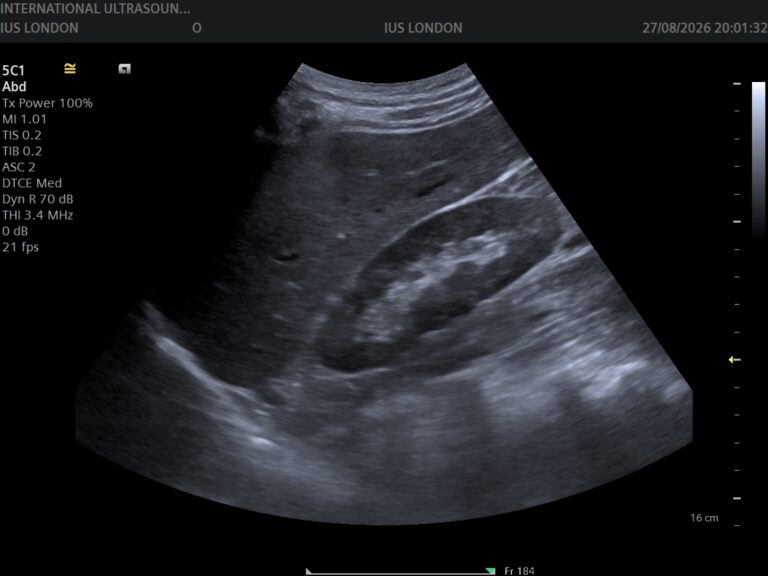
The key measurement is endometrial thickness — how thick the lining of the womb is, taken on a transvaginal scan. After menopause the lining should be thin, and a thin, regular lining of 4 mm or less — the threshold most UK pathways use — makes cancer very unlikely.
A lining thicker than that, an irregular one, or fluid in the cavity does not mean cancer; most people in that group turn out to have polyps or benign thickening. What it means is that the lining needs to be looked at directly, usually with a biopsy or a hysteroscopy at a gynaecology clinic — that step is the system working, not a diagnosis. The same scan also checks for polyps and fibroids and looks at both ovaries.
How the pathway runs
Tell your GP about the bleeding — this week, not next month. Because the symptom is taken seriously, GPs refer postmenopausal bleeding on an urgent pathway and hospital assessment happens quickly on the NHS. It is one of the better-run routes in the system, and it exists precisely so that the benign majority can be reassured fast and the minority treated early.
Where does a private scan fit? Honestly: as a supplement. It can measure the lining within days and hand you a written report to carry into the GP appointment, which some people find steadies the wait. What it must never do is delay or replace the referral — whatever our scan shows, the GP visit still happens. We will tell you the same thing in the room.

What we do — alongside your GP, not instead
- 1
BookingNo referral needed — and we will still advise you to see your GP whatever the scan shows. Both can happen in the same week.
- 2
The scanA transvaginal scan gives the accurate lining measurement this symptom needs; it is gentle, and a transabdominal approach is available if you prefer. The appointment is 30 minutes.
- 3
What we measureEndometrial thickness and pattern, any polyp or fibroid, fluid in the cavity, and both ovaries.
- 4
ResultsExplained on screen at the appointment, with the written report usually with you within two hours — written so your GP or the hospital team can act on it directly.
Your questions answered
Does postmenopausal bleeding mean cancer?
It was one small spot and it has stopped. Does that count?
I am on HRT — is bleeding expected?
What does the 4 mm threshold actually mean?
My scan was normal. Am I in the clear?
How quickly should I act?
Where to go from here
Answers quickly — pathway respected
Endometrial thickness measured properly on a transvaginal scan, explained at the appointment, with the written report usually within two hours — to carry into your GP visit, not to replace it.
Kensington, London W8 4ED
3 mins from Notting Hill Gate
This article is general information about postmenopausal bleeding, not individual medical advice. Any bleeding after menopause should be reported to your GP promptly, whatever a private scan shows — NHS guidance on postmenopausal bleeding explains the assessment pathway.
Written and clinically reviewed by the HCPC-registered sonographers who perform this scan at IUS London — a CQC-registered diagnostic ultrasound clinic (Provider ID 1-2775844974). Your own findings are explained to you at the scan and set out in your report.
Author: Yianni Kiromitis, Senior Sonographer, HCPC RA38415 — over 20 years’ experience in NHS and private ultrasound
Medically reviewed: 9 August 2026