Pelvic Infection in Women — Causes, Symptoms and What a Scan Shows
How infection reaches the womb, tubes and ovaries, what it feels like, why a normal ultrasound does not rule it out — and why treating it quickly matters more than imaging it.

Pelvic infection — often called pelvic inflammatory disease, or PID — is infection of the upper female reproductive tract: the womb (uterus), the fallopian tubes, and sometimes the ovaries and surrounding tissue. People search for it in plainer words too: an infection in the uterus, a womb infection, an infection in the ovaries. They are describing the same territory.
One thing is worth saying at the outset, because it changes what you should do next: a pelvic ultrasound is frequently completely normal in mild or early pelvic infection. The diagnosis is made clinically — from your symptoms, an examination, and swabs — not from a scan. If you have the symptoms below, the appointment that matters is with your GP or a sexual health clinic, and it should be soon. Imaging has a real role, but it is a supporting one.
Severe lower abdominal pain, a temperature of 38°C or above with pelvic pain, vomiting and unable to keep fluids down, feeling faint, or any of these while pregnant or recently pregnant. Go to A&E or call 999 for severe or worsening symptoms. Severe pelvic infection can lead to an abscess or sepsis, and pain of this kind also needs an ectopic pregnancy excluded.
How pelvic infection happens
Almost always, bacteria travel upwards from the vagina and cervix into the womb and tubes — structures that are normally sterile. What differs is where the bacteria come from.
Sexually transmitted infection is the commonest route. Chlamydia trachomatis and Neisseria gonorrhoeae account for a large share of cases. Both frequently cause no symptoms at all in their early stages, which is precisely how they reach the upper tract unnoticed — and why testing matters even when you feel well.
Bacteria that are not sexually transmitted can also be responsible, including organisms normally present in the vagina that overgrow or gain access, sometimes in association with bacterial vaginosis.
After pregnancy or a procedure. Infection of the womb lining — endometritis — can follow childbirth, miscarriage or termination, and occasionally follows procedures that pass through the cervix, such as coil (IUD) insertion or surgery on the womb. The risk after coil insertion is small and mainly confined to the first few weeks.
What raises the chance: a previous episode of pelvic infection, being under 25 and sexually active, new or multiple partners, sex without barrier contraception, and recent instrumentation of the womb. Douching is also discouraged, as it disturbs the vagina’s own protective balance.
Symptoms — and why they are easy to dismiss
Pelvic infection ranges from silent to severe, and the mild end is the problem: symptoms are vague enough to be attributed to a period, a stomach upset, or thrush.
- Pain low in the abdomen or pelvis — often on both sides, dull rather than sharp
- Unusual vaginal discharge — changed in colour, consistency or smell
- Pain during sex, particularly felt deep
- Bleeding between periods or after sex, or heavier periods than usual
- Pain or burning on passing urine — which is why it is sometimes mistaken for a urinary infection
- Fever, feeling generally unwell — in more established infection
Because early infection can be silent, some cases are only recognised later, when investigating difficulty conceiving or persistent pelvic pain. That is not a reason for alarm, but it is a good reason to have symptoms checked rather than waited out.
What a pelvic ultrasound can and cannot show
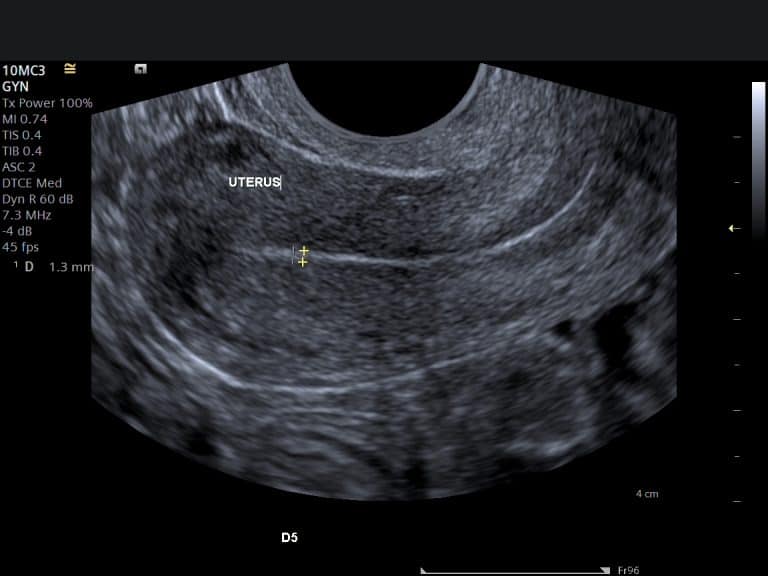
It cannot diagnose the infection itself. Inflammation of the womb lining and tubes often produces no visible change on ultrasound, so a normal scan does not exclude pelvic infection and should never be taken as the all-clear. Swabs and clinical assessment do that work.
What imaging is genuinely for:
| What the scan may show | What it means |
|---|---|
| Tubo-ovarian abscess | A collection of pus involving tube and ovary — a serious complication needing hospital treatment |
| Hydrosalpinx or pyosalpinx | A fallopian tube distended with fluid or pus. Normal tubes are not visible at all, so a visible tube is itself the finding |
| Free fluid in the pelvis | Non-specific alone, but supportive alongside symptoms |
| A thickened or fluid-filled endometrium | May accompany infection of the womb lining, particularly after pregnancy or a procedure |
| Normal appearances | Common in mild infection — reassuring about complications, but not a negative result for infection |
Ultrasound also does something valuable that has nothing to do with confirming infection: it excludes other causes of the same symptoms — an ectopic pregnancy, ovarian torsion, or a complication of an ovarian cyst, all of which can present as acute pelvic pain and need entirely different management. Our guide to reading a pelvic report explains the terminology.
What happens, and why speed matters
Treatment is a course of antibiotics, usually a combination covering the likely organisms, and it is typically started on clinical suspicion before swab results return — because waiting costs more than treating. Most people are treated at home; hospital admission is reserved for severe infection, abscess, pregnancy, or failure to improve.
Two practical points that get skipped. Finish the course even once you feel better, and avoid sex until you and any partner have completed treatment. Current and recent partners need testing and treatment too — otherwise reinfection is likely. Sexual health clinics do this routinely, confidentially and free, and can notify partners on your behalf without naming you.
Prompt treatment matters because untreated infection can scar the fallopian tubes, and scarring is what leads to the longer-term consequences — difficulty conceiving, a raised risk of ectopic pregnancy, and chronic pelvic pain. Treated promptly, most women recover fully without any of these. That is the honest framing: not a reason to panic, a reason not to postpone the appointment.
Your questions answered
Can a pelvic ultrasound detect infection?
What causes an infection in the uterus?
Does pelvic inflammatory disease always show on a scan?
Can you get pelvic infection without an STI?
Can a coil cause a pelvic infection?
Will pelvic infection affect my fertility?
Should I go to my GP or a sexual health clinic?
Where to go from here
When imaging is the right next step
Pelvic scanning by HCPC-registered sonographers to look for complications and exclude other causes of pain, explained on screen, with a written report usually within two hours. For suspected infection itself, see your GP or a sexual health clinic first.
Kensington, London W8 4ED
3 mins from Notting Hill Gate
This article is general information, not individual medical advice. Suspected pelvic infection should be assessed promptly by your GP or a sexual health clinic, where treatment is usually started on clinical grounds rather than waiting for test results. Severe pain, high fever, or symptoms during or soon after pregnancy need same-day assessment.
Written and clinically reviewed by the HCPC-registered sonographers who perform this scan at IUS London — a CQC-registered diagnostic ultrasound clinic (Provider ID 1-2775844974). Your own findings are explained to you at the scan and set out in your report.
Author: Yianni Kiromitis, Senior Sonographer, HCPC RA38415
Medically reviewed: 1 August 2026