Thyroid Nodule Surveillance — How Often and Why
Most nodules need watching rather than treating. Here is what determines whether yours is followed up, how often, and when surveillance stops.

Thyroid nodules are common — increasingly so with age, and more often found now simply because we scan necks more than we used to. The substantial majority are benign. That creates the central problem of thyroid surveillance: how do you follow the small number that matter without subjecting everyone else to years of unnecessary scanning and worry?
The answer is risk stratification. Ultrasound appearance, size, and whether anything has changed since last time together determine what happens next.
What determines follow-up
| Factor | Why it matters |
|---|---|
| Ultrasound appearance | Features such as shape, margins, internal composition and microcalcification are graded into risk categories. This drives the decision more than size does. |
| Size | Larger nodules are more likely to be sampled; very small ones with reassuring features are often left alone entirely. |
| Change over time | Meaningful growth between scans, or a change in appearance, prompts reassessment even in a previously reassuring nodule. |
| Previous FNA result | A benign sampling result usually reduces the intensity of follow-up considerably. |
| Your history | Previous neck radiation, a family history of thyroid cancer, or associated symptoms all raise the threshold for watchful waiting. |
Intervals therefore vary legitimately — from no follow-up at all for small, clearly benign-appearing nodules, through checks at intervals of a year or more, to prompt sampling for higher-risk appearances. Anyone quoting a single universal schedule is oversimplifying; your endocrine team’s plan is the one to follow.
Two things a scan cannot do
It cannot tell you a nodule is benign with certainty. Ultrasound features indicate probability, which is why higher-risk appearances lead to fine needle aspiration — a small sample taken with a needle, and the only test that classifies a nodule definitively. We do not perform FNA; if a nodule meets the criteria, the report says so and your GP or endocrine clinic arranges it.
It cannot tell you how your thyroid is working. Tiredness, weight change, palpitations, feeling too hot or too cold — these are hormone questions answered by blood tests through your GP. A gland can look structurally normal with abnormal hormone levels, and a nodular gland can function perfectly well. Imaging and function are separate enquiries, and confusing them leads people to buy the wrong test.
Do not wait for the next scheduled scan if things change
A nodule that grows noticeably, a new hoarse voice lasting more than three weeks, difficulty swallowing or breathing, or a hard fixed lump should go to your GP promptly rather than waiting for a surveillance appointment. Rapid neck swelling with breathing difficulty needs same-day care.
How a surveillance scan runs
- 1
Bring your previous report if you have itSurveillance is about comparison. Previous measurements make this scan far more useful than a standalone one. 30 minutes, no referral, no preparation.
- 2
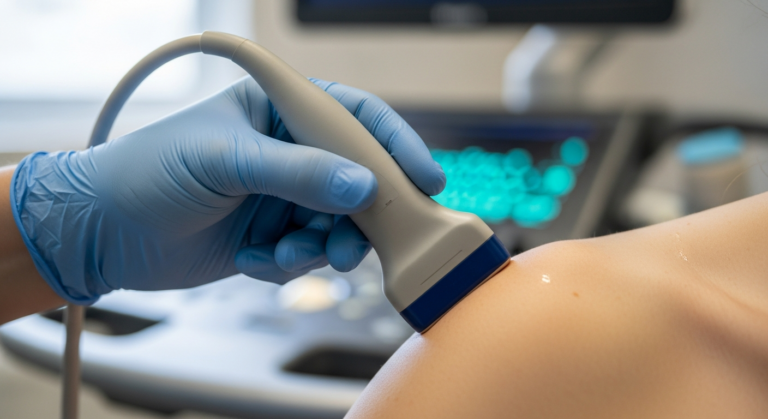
The scanLying back with the neck gently extended. Warm gel and a small probe — painless.
- 3
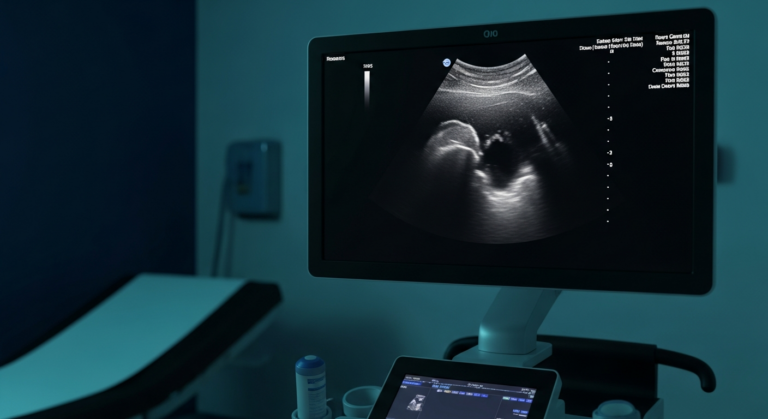
What we measureEach nodule in three dimensions with its ultrasound features described, the rest of the gland, and the lymph nodes in the neck.
- 4
ResultsExplained on screen as we scan, written report usually within two hours — with measurements set out so your endocrine team can compare them directly against your previous scans.
Your questions answered
How often should a thyroid nodule be rescanned?
What counts as significant growth?
Do all nodules need a needle test?
Can surveillance ever stop?
Will a scan tell me if I need thyroid medication?
Should I bring my old scans?
Measured for comparison, not just described
Every nodule measured in three dimensions with its features documented, plus the whole gland and neck nodes — explained on screen as we scan, with the report usually within two hours for your endocrine team.
Kensington, London W8 4ED
3 mins from Notting Hill Gate
This article is general information about thyroid nodule follow-up, not individual medical advice. Follow the surveillance plan set by your GP or endocrine team — see NHS guidance on thyroid cancer and thyroid function. We do not offer fine needle aspiration, biopsy or blood tests.
Written and clinically reviewed by the HCPC-registered sonographers who perform this scan at IUS London — a CQC-registered diagnostic ultrasound clinic (Provider ID 1-2775844974). Your own findings are explained to you at the scan and set out in your report.
Author: Yianni Kiromitis, Senior Sonographer, HCPC RA38415 — over 20 years’ experience in NHS and private ultrasound
Medically reviewed: 9 August 2026