Leg Pain After a Long Flight — Should I Worry?

Leg Pain After a Long Flight — Should I Worry?

Stepping off a long-haul flight should mark the beginning of a well-earned holiday or a successful return home. You expect a degree of fatigue and perhaps some jet lag. What you do not expect is a persistent, nagging ache or unusual heaviness in your leg.

If you are currently experiencing leg pain after a flight, you are likely navigating a complex mix of physical discomfort and psychological anxiety. You may be wondering if you have simply strained a muscle while wrestling with luggage, or if you are experiencing the early signs of "economy class syndrome"—clinically known as travel thrombosis.

At IUS London, we understand that medical uncertainty is a heavy burden, particularly when it comes to your vascular health. The fear of a Deep Vein Thrombosis (DVT) can overshadow your post-travel plans.

This comprehensive guide is designed to provide you with absolute clarity. We will explore the mechanics of travel-related leg pain, identify your personal risk factors, and explain exactly when you should seek immediate help, and when a definitive diagnostic ultrasound is your best course of action.

⚠ 🚨 RED FLAGS: When to Seek Immediate Emergency Care

Before we explore the nuances of post-flight leg pain, we must establish the absolute medical boundaries. Deep Vein Thrombosis (DVT) can occasionally lead to a Pulmonary Embolism (PE)—a life-threatening condition where a blood clot breaks free and travels to the lungs.

Do not wait for a private scan if you experience any of the following. Proceed immediately to your nearest Accident & Emergency (A&E) department or call 999:

  • Sudden Shortness of Breath: Difficulty breathing that appears without warning or exertion.
  • Chest Pain: A sharp, stabbing pain in the chest that may worsen when you inhale deeply or cough.
  • Coughing up Blood: Any haemoptysis (blood in your sputum) is an absolute medical emergency.
  • Severe, Rapid Leg Swelling: Swelling that appears suddenly, particularly if it affects only one leg (unilateral).
  • Skin Discoloration and Heat: The affected leg becomes noticeably red, purple, or blue, and feels unusually hot to the touch.
  • Unexplained Dizziness or Fainting: Feeling lightheaded or losing consciousness.

If you do not have these emergency symptoms but are still experiencing isolated leg pain, swelling, or tenderness, continue reading to understand your risks and your next steps.

The Mechanics of Travel Thrombosis: Why Flights Trigger Leg Pain

To understand why your leg hurts, we must look at what happens to your circulatory system at 35,000 feet.

The human vascular system is a marvel of engineering, but it relies heavily on movement. The veins in your legs depend on the contraction of your calf muscles to pump deoxygenated blood back up to your heart against the force of gravity.

The Role of Immobility

When you are seated on a long-haul flight (typically defined as any flight lasting longer than four hours), this muscular pump is essentially deactivated. This prolonged immobility leads to venous stasis—a pooling of sluggish blood in the lower extremities.

When blood flows too slowly, its cellular components can begin to aggregate, creating the perfect environment for a thrombus (blood clot) to form.

The Cabin Environment

Immobility is not the only culprit. The cabin environment itself acts as a catalyst. The slightly lower oxygen levels (mild hypoxia) and lower atmospheric pressure can subtly alter blood coagulation pathways.

Furthermore, the low humidity in an aircraft cabin accelerates invisible fluid loss through respiration and the skin. If you do not actively hydrate, your blood becomes slightly more viscous (thicker), further increasing the friction within your veins.

The Crucial 4-Week Risk Window

There is a dangerous psychological trap associated with travel thrombosis: the belief that if you land without pain, you are in the clear.

From a clinical perspective, the risk-window for developing a travel-related DVT extends for up to 4 weeks post-travel. A microscopic clot may form during the flight but take days or even weeks to accumulate enough mass to obstruct blood flow and cause noticeable pain or swelling.

If you experience unexplained leg pain two or three weeks after returning from a long trip, travel thrombosis must remain a primary consideration.

Personal Risk Factors: Are You Highly Susceptible?

Travel-related DVT rarely happens in a vacuum. It is usually the result of a "perfect storm" combining the environmental trigger of the flight with an individual's underlying physiological risk factors.

Understanding your personal risk profile is vital for contextualising your current leg pain.

1. Hormonal Factors (OCP and HRT)

The use of oestrogen-based medications, particularly the combined Oral Contraceptive Pill (OCP) or Hormone Replacement Therapy (HRT), significantly elevates baseline coagulation levels. When combined with the immobility of a long flight, the risk multiplies.

2. Pregnancy and the Postpartum Period

Pregnancy naturally induces a hypercoagulable state—an evolutionary mechanism designed to prevent excessive bleeding during childbirth. Additionally, the growing uterus places physical pressure on the pelvic veins, slowing blood return from the legs. This elevated risk persists throughout the pregnancy and well into the postpartum period.

3. Personal or Family Clotting History

If you have previously suffered from a DVT or Pulmonary Embolism, your venous architecture may already be compromised, making you highly susceptible to recurrence. Similarly, a known genetic predisposition, such as Factor V Leiden mutation, dramatically lowers the threshold for clot formation during periods of immobility.

4. Age and Body Composition

While a DVT can occur at any age, the risk increases progressively after the age of 40. A higher Body Mass Index (BMI) also places additional mechanical stress on the venous system and is associated with increased baseline inflammation, further promoting coagulation.

5. Recent Surgery or Trauma

If you are flying shortly after major surgery—particularly orthopaedic procedures involving the hips or knees—your body is already in an active state of tissue repair and heightened coagulation.

DVT vs. Normal Travel Swelling vs. Muscle Strain

When anxiety strikes, every twinge in the calf can feel like a blood clot. However, there are several benign reasons your leg might hurt after travelling.

Dependent oedema (fluid retention from sitting) and muscular cramps are incredibly common. The table below outlines the general clinical differences between these conditions.

Clinical FeatureDeep Vein Thrombosis (DVT)Dependent Oedema (Fluid Pooling)Muscular Strain / Cramp
**Symmetry**Usually **Unilateral** (affects only one leg).Usually **Bilateral** (affects both legs equally).Usually Unilateral (isolated to the strained muscle).
**Type of Pain**Deep, throbbing ache or heavy cramp that does not ease with rest or stretching.Generally painless, though legs may feel "heavy" or tight.Sharp, acute pain that worsens with specific movements or stretching.
**Swelling**Noticeable swelling in the calf, ankle, or thigh of the affected leg.Mild to moderate puffiness around both ankles and feet.Minimal to no swelling, unless a severe tear has occurred.
**Skin Changes**Skin may be red, discoloured, tightly stretched, and unusually warm.Skin looks normal, though socks may leave deep indentations.Skin looks normal; may have isolated bruising if traumatised.
**Onset**Gradual; can occur during the flight or **up to 4 weeks** later.Occurs during the flight; resolves within 24-48 hours of elevation.Sudden onset, often linked to a specific movement (e.g., lifting luggage).

Disclaimer: This table is for informational purposes only. A DVT can present atypically. If you are unsure, diagnostic imaging is the only way to rule out a blood clot.

[SUGGESTED — verify with clinician] From Our Practice: A Typical Post-Flight Presentation

The following is an anonymised composite of clinical presentations frequently observed at IUS London.

The Patient: A 42-year-old female executive returning to London after a 12-hour direct flight from Singapore.

The Presentation: Three days after landing, she noticed a dull ache in her right calf. She initially dismissed it as a cramp from dehydration and walking around the airport. By day five, the ache had transitioned into a persistent throbbing, and her right ankle appeared slightly more swollen than her left.

The Context: She was otherwise healthy, a non-smoker, but was currently taking a combined oral contraceptive pill.

The Triage & Action: Recognising the combined risk factors (prolonged immobility + OCP), she contacted IUS London. Our clinical triage team advised an immediate Venous Duplex Ultrasound.

The Outcome: The scan was performed the same day in our premium clinic. The sonographer identified a small, non-occlusive thrombus (early-stage DVT) in the popliteal vein behind her right knee. Because it was caught early, she was immediately referred for outpatient anticoagulant therapy, completely avoiding a hospital admission or the risk of a pulmonary embolism.

This case highlights a critical operational reality: Waiting to see if the pain improves is a dangerous strategy when vascular health is at stake.

The Definitive Answer: Venous Duplex Ultrasound

When you are dealing with potential travel thrombosis, clinical examination alone is insufficient. Up to 50% of DVTs do not present with classic textbook symptoms.

The gold standard for diagnosing or ruling out a DVT is a Venous Duplex Ultrasound scan.

What is a Duplex Scan?

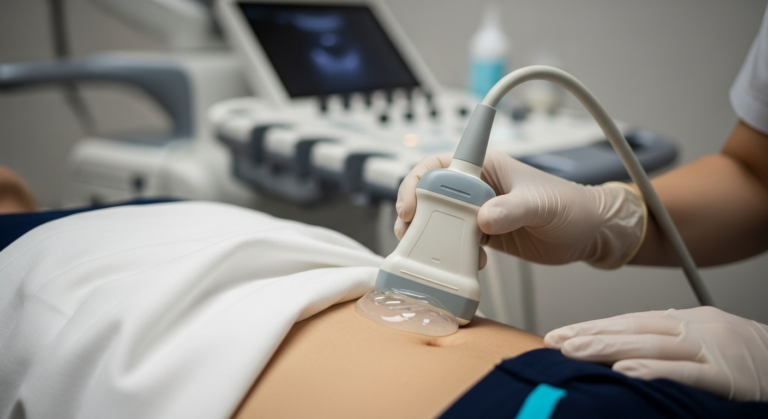
A duplex ultrasound is a highly advanced, completely non-invasive imaging technique that combines two distinct types of ultrasound:

1. Traditional (B-mode) Ultrasound: This creates a high-resolution, structural picture of the veins in your legs, allowing the sonographer to visually check for blockages.

2. Doppler Ultrasound: This measures the direction and speed of blood flow within the vessel.

Why is it the Gold Standard?

During the scan, the sonographer will perform a "compression test." A healthy vein will easily compress when gentle pressure is applied with the ultrasound probe. If a blood clot is present, the vein will remain rigid and unyielding.

This immediate, visual confirmation allows for definitive answers. There is no radiation, no needles, and zero downtime.

Most importantly, a duplex scan provides absolute psychological relief. If the scan is clear, you can return to your life with complete peace of mind, knowing that your leg pain is muscular or skeletal, rather than vascular. If a clot is found, immediate, life-saving treatment can begin without delay.

Peace of Mind is a Scan Away

Leg pain after a long flight should never be ignored. While it is entirely possible that your discomfort is the result of a harmless muscular strain or temporary fluid retention, the stakes associated with travel thrombosis are simply too high to leave to chance.

Remember, the risk-window extends for up to 4 weeks post-travel. You do not need to sit at home, monitoring your calf with growing anxiety, waiting to see if the swelling worsens.

At IUS London, we believe that premium healthcare means immediate access to definitive answers. Our expert sonographers utilize state-of-the-art diagnostic equipment in a calm, luxurious environment, ensuring you receive the highest standard of clinical care without the stress of hospital waiting rooms.

Don't let vascular anxiety ruin your post-travel peace.

[Book a Private Deep Vein Thrombosis (DVT) Ultrasound Scan at IUS London Today]

Secure your appointment online for rapid access to expert vascular imaging and immediate clinical clarity.

References

1. Pastori, D., Cormaci, V. M., Marucci, S., Franchino, G., Del Sole, F., Capozza, A., Fallarino, A., Corso, C., Valeriani, E., & Pignatelli, P. (2023). A Comprehensive Review of Risk Factors for Venous Thromboembolism: From Epidemiology to Pathophysiology. International Journal of Molecular Sciences. https://consensus.app/papers/details/3586d872ae0f51d59357e9d757b664da/

2. Karsanji, D., Ghesquiere, W., & Johnston, V. (2019). The risk and prevention of venous thromboembolism in the pregnant traveler. Journal of travel medicine. https://consensus.app/papers/details/53cb2fea86bc56558849f99ae9353ec6/

3. Philbrick, J., Shumate, R., Siadaty, M., & Becker, D. (2007). Air Travel and Venous Thromboembolism: A Systematic Review. Journal of General Internal Medicine. https://consensus.app/papers/details/45b3a0e6545f5fe7bf2dbe63d2245a1c/

Book Your Private Ultrasound Scan in London

Same-day appointments available in Kensington. No GP referral required. HCPC-registered consultant sonographers.