Stomach Pain After Eating — Causes and When to Scan
When pain arrives, where it sits and what you ate beforehand usually narrows it down. Here is what an abdominal ultrasound finds — and the common causes it cannot see at all.

Pain that reliably follows meals is a useful symptom, because the timing and the trigger food point somewhere specific. The classic pattern — severe pain under the right ribs an hour or two after something fatty, sometimes spreading to the right shoulder blade — is gallstones, and it is the single most common finding when we scan people with this complaint.
Symptoms that need urgent care, not a booked scan
Severe abdominal pain that will not settle, pain with fever or yellowing of the skin or eyes, vomiting blood, or black tarry stools need same-day assessment — NHS 111 or A&E. Difficulty swallowing, persistent vomiting, unintentional weight loss, or a lump in the abdomen should go to your GP promptly; these are symptoms the NHS assesses on an urgent pathway.
What the timing and location suggest
| What you notice | Commonly | Ultrasound? |
|---|---|---|
| Severe pain under the right ribs 1–2 hours after fatty food, sometimes to the right shoulder blade | Gallstones | Yes — seen well |
| Burning behind the breastbone, worse lying down or bending | Reflux | No |
| Gnawing upper abdominal pain, sometimes relieved or worsened by food | Ulcer or gastritis | No — needs endoscopy |
| Bloating, cramping, changes in bowel habit, pain eased by opening bowels | Irritable bowel syndrome | No — but helps exclude others |
| Pain with bloating and diarrhoea after specific foods | Food intolerance or coeliac disease | No — blood tests and endoscopy |
| Severe pain boring through to the back, with vomiting | Pancreas — needs urgent assessment | Partly — urgent care first |
What an abdominal ultrasound does and does not see
Worth stating plainly, because the name misleads: an abdominal ultrasound does not examine the stomach itself. Gas-filled organs scatter sound, so the stomach, bowel and much of the gut are effectively invisible. If your symptoms point at gastritis, an ulcer, coeliac disease or IBS, a scan will not diagnose them — that is endoscopy and blood tests, arranged through your GP.
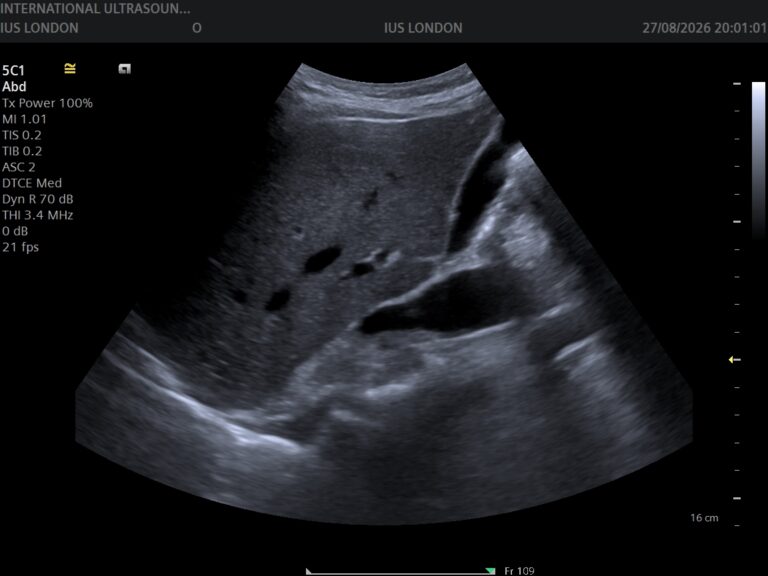
What it does see, and sees well: the gallbladder and stones within it, the bile ducts, the liver’s size and texture including fatty change, the kidneys, the spleen, the aorta, and much of the pancreas. That is a genuinely useful list — and for the fatty-food pain pattern above, it is usually the test that answers the question.
So the sensible framing is: a scan is excellent for gallbladder and liver questions, and a reasonable way to exclude those causes before pursuing a gut diagnosis elsewhere. It is not a general abdominal all-clear.
How the appointment runs
- 1
Preparation matters hereDo not eat for four hours before an abdominal scan. Food empties the gallbladder, and a contracted gallbladder can hide stones. Water is fine, and take your usual medicines.
- 2
The scanLying on your back with warm gel, sometimes rolling onto your side. We will ask you to take a deep breath in and hold — it brings the liver and gallbladder down into view. 30 minutes.
- 3
What we assessGallbladder and bile ducts, liver size and texture, both kidneys, spleen, pancreas as far as bowel gas allows, and the aorta.
- 4
ResultsExplained on screen as we scan, with the written report usually with you within two hours — and if your symptoms point at the gut rather than the gallbladder, the report says so.
Your questions answered
How long do I need to fast before an abdominal scan?
Can an ultrasound see my stomach lining?
Do gallstones always need surgery?
Could it be my pancreas?
My scan was normal but I still have pain. What now?
Should I have the urinary tract scanned too?
Where to go from here
Answer the gallbladder question first
Gallbladder, bile ducts, liver, kidneys, spleen, pancreas and aorta assessed in one 30-minute appointment — explained on screen as we scan, with the written report usually within two hours for your GP.
Kensington, London W8 4ED
3 mins from Notting Hill Gate
This article is general information about abdominal pain, not individual medical advice. Severe unremitting pain, fever with jaundice, vomiting blood or black stools need same-day assessment — see NHS guidance on stomach ache and gallstones. Ultrasound does not assess the stomach lining or bowel; we do not offer endoscopy, blood tests or CT.
Written and clinically reviewed by the HCPC-registered sonographers who perform this scan at IUS London — a CQC-registered diagnostic ultrasound clinic (Provider ID 1-2775844974). Your own findings are explained to you at the scan and set out in your report.
Author: Yianni Kiromitis, Senior Sonographer, HCPC RA38415 — over 20 years’ experience in NHS and private ultrasound
Medically reviewed: 9 August 2026