General Health · Question Hub

Thyroid Ultrasound — Common Questions Answered

What the scan shows, what it genuinely cannot tell you, and what happens when a nodule turns up — the questions we answer every week, in one place.
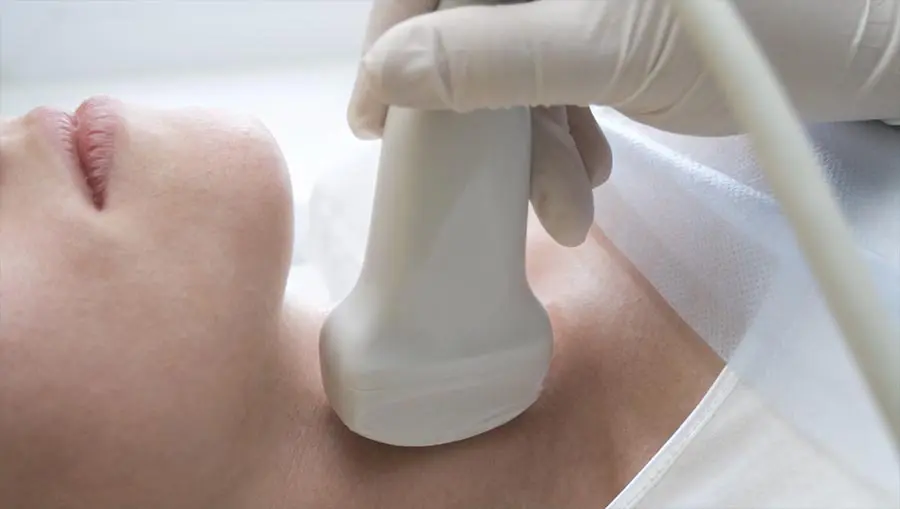
Private thyroid scan in London

The thyroid is a butterfly-shaped gland at the front of the neck, wrapped around the windpipe just above the collarbones. It makes the hormones thyroxine (T4) and triiodothyronine (T3), which set the pace of almost every tissue in the body — heart rate, metabolism, energy. When something feels wrong in the neck, or blood tests raise a question, ultrasound is the first-line imaging for the thyroid: it shows the gland’s size, texture and any nodules in real time, with no radiation and no preparation. One distinction runs through every answer below and is worth stating up front: ultrasound shows the thyroid’s structure; blood tests measure its function. The two answer different questions, and an honest clinic tells you which one yours is.

Your Questions

Thyroid ultrasound, question by question

What does a thyroid ultrasound actually show?
The gland’s size and texture, both lobes and the isthmus connecting them, blood flow on Doppler, and — most importantly — any nodules: their size, composition (solid, fluid-filled, or mixed) and the features that determine whether they matter. It also shows the neighbouring structures, so a lump you can feel can be traced to its true origin.
Why has my GP suggested one?
The common reasons: working out whether a neck lump arises from the thyroid or something next to it; characterising a nodule that was felt on examination; checking for additional nodules; measuring whether a known nodule has grown; or investigating a visibly enlarged gland (a goitre). Ultrasound is far more sensitive than examining fingers — it routinely shows nodules that cannot be felt.
What kinds of thyroid problems are there?
Broadly four groups: hormone problems (an overactive or underactive gland), enlargement (goitre — sometimes purely cosmetic, sometimes pressing on neck structures), nodules (very common, overwhelmingly benign), and — least commonly — thyroid cancer. Ultrasound assesses the structural three directly; hormone problems are a blood-test matter, though the scan often contributes context.
Can ultrasound tell me if my thyroid is overactive or underactive?
No — and any clinic implying otherwise is overselling. Thyroid function is measured by blood tests (TSH, T4, T3) arranged through your GP. Ultrasound shows structure. The two are complementary: an abnormal blood test plus a scan often completes the picture, but neither replaces the other.
Can ultrasound tell if a nodule is cancer?
Not definitively — but it is very good at sorting nodules by risk. The vast majority are benign, and specific ultrasound features (composition, margins, shape, calcifications) determine whether a nodule can simply be observed or has features that warrant a needle biopsy, arranged through your GP or a specialist. Our guide to the symptoms of thyroid cancer covers the warning signs that should prompt review regardless of any scan.
What happens if a nodule is found?
You will know before you leave: what it is, how it measures, and what — if anything — it needs. Most benign-appearing nodules simply get a documented size and, where appropriate, a surveillance interval — our guide to thyroid nodule follow-up intervals explains the schedules. Nodules with features that need more are routed honestly and promptly, with a report your GP or endocrinologist can act on.
How do I prepare, and what happens at the appointment?
No preparation at all — eat and drink normally. You lie on your back, sometimes with a small pillow under the shoulders to gently extend the neck (tell us about any neck pain and we will position you comfortably); warm gel and a small probe over the front of the neck; around 30 minutes in total, painless, and you resume your day immediately.
Is it safe — and do I need a referral?
Completely — ultrasound uses sound waves, not radiation, with no known harmful effects at diagnostic levels; our guide Is Ultrasound Safe? covers the full picture. No GP referral is needed to book with us, and your written report — usually within two hours — is written for your GP to act on.
From Our Practice

The two patterns behind most thyroid scans

The commonest story is a lump someone has felt in the mirror — and a good proportion of those turn out not to be thyroid at all, but a lymph node or a benign cyst sitting nearby. The second is the reverse: a nodule nobody felt, spotted incidentally on a scan done for something else. Both end the same way — with the finding named, measured, and given an honest plan.

That is why the examination always maps the whole neck compartment around the gland, not just the thyroid itself — and why a felt lump that isn’t thyroid still gets a proper answer at the same appointment. If your starting point is a lump rather than a thyroid question, our guide to neck lumps — thyroid, lymph node or cyst walks through the possibilities.

A thyroid question deserves a same-week answer

Thyroid and neck mapped in one 30-minute appointment, findings explained on screen, written report usually within two hours.

£179
Thyroid & neck scan

Book a Scan

5a Lucerne Mews
Kensington, London W8 4ED
3 mins from Notting Hill Gate

This article is general information, not individual medical advice. Thyroid function testing and biopsy decisions sit with your GP or specialist — our reports are written to support exactly those decisions. If in doubt about a symptom, speak to your GP or call NHS 111.

Written and clinically reviewed by the HCPC-registered sonographers who perform this scan at IUS London — a CQC-registered diagnostic ultrasound clinic (Provider ID 1-2775844974). Your own findings are explained to you at the scan and set out in your report.

Author: Yianni Kiromitis, Senior Sonographer, HCPC RA38415
Medically reviewed: 31 July 2026